
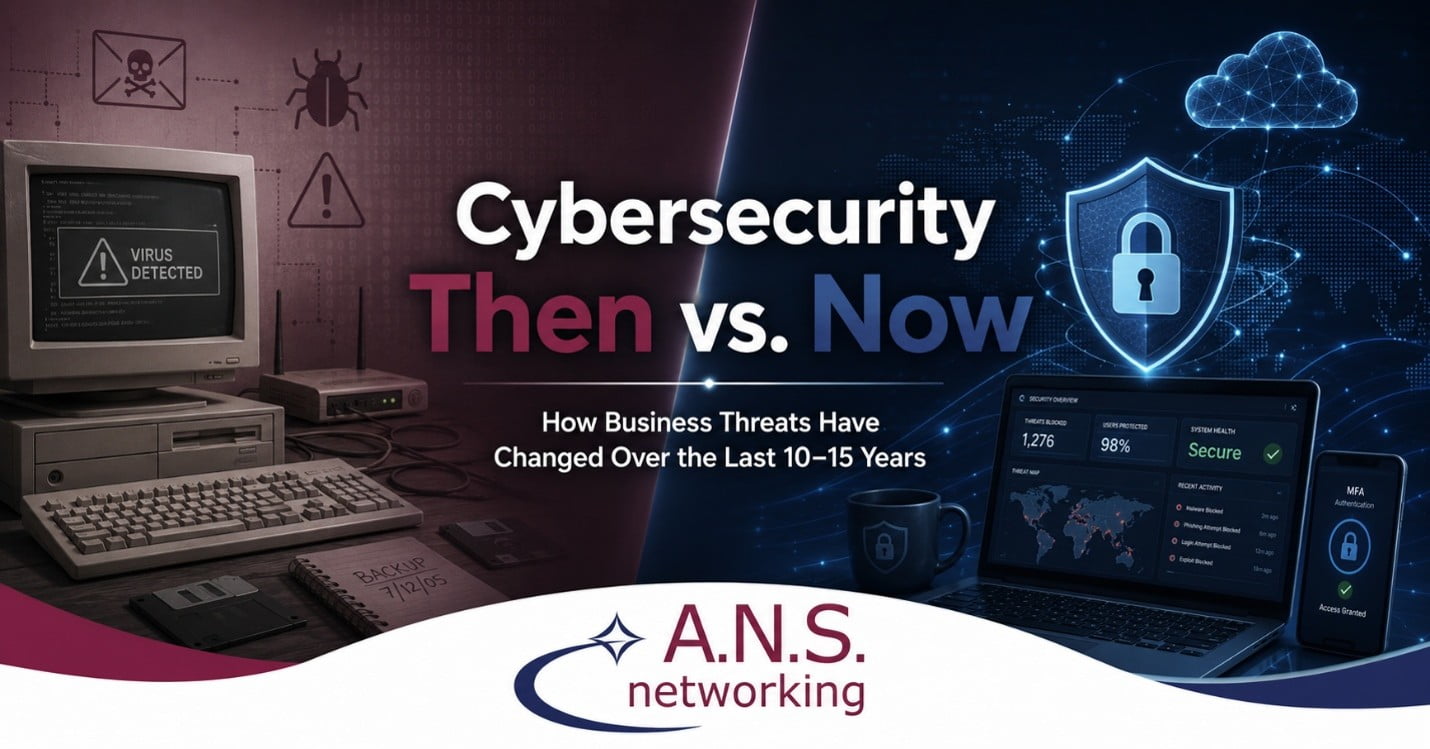
Technology has changed dramatically over the last 10 to 15 years. Businesses now depend on email, cloud applications, online banking, shared files, remote access, mobile devices, and digital communication to operate every day.
Unfortunately, cybercriminals have evolved right alongside that technology.
Years ago, many cyberattacks were easier to recognize. A computer virus might have caused constant pop-ups, slowed down a device, displayed an unusual message, or prevented certain programs from opening. While these issues could still be disruptive, the signs were often obvious.
Today’s cyberattacks can be much quieter, more targeted, and far more damaging.
Cybersecurity Then: Visible Viruses and Individual Computers
Ten or 15 years ago, a typical cybersecurity issue may have involved:
- A virus downloaded from an unsafe website
- A suspicious email attachment
- Pop-ups or unwanted programs
- One infected computer
- A device that became slow or unusable
- Files that needed to be restored or programs that needed to be reinstalled
In many cases, the problem was isolated to a single device. A technician could remove the infection, repair the computer, and get the employee back to work.
Businesses still needed antivirus protection, backups, and reliable IT support, but the overall threat landscape was not as organized or sophisticated as it is today.
Cybersecurity Now: Quiet, Targeted, and Highly Organized
Modern cybercriminals are often patient.
Instead of immediately disrupting a device, an attacker may quietly gain access to an email account, network, or cloud application and remain undetected. During that time, they may study how the company operates, identify decision-makers, monitor conversations, and wait for the right opportunity to strike.
Today’s attacks may include:
- Stealing usernames and passwords
- Impersonating executives or vendors
- Sending convincing fraudulent invoices
- Redirecting payments to criminal bank accounts
- Encrypting company files through ransomware
- Stealing sensitive customer or employee information
- Disabling or deleting backups
- Gaining access through an unmanaged personal device
- Using artificial intelligence to create more convincing phishing messages
- Targeting businesses through trusted vendors or third-party accounts
These attacks are not always obvious. In some cases, the first warning may be a fraudulent payment, an employee who suddenly cannot access files, a customer reporting a suspicious email, or an entire company being locked out of its systems.
Phishing Emails Have Become Much More Convincing
Older phishing emails were often easier to recognize. They may have contained poor spelling, strange formatting, unusual links, or messages that clearly did not match the company sending them.
Today, phishing attempts can look almost identical to legitimate emails.
Cybercriminals can research a business online, learn the names of employees, identify vendors, review social media activity, and create messages based on real relationships or current projects.
A fraudulent email may appear to come from:
- The company owner
- A manager or coworker
- A trusted vendor
- A financial institution
- Microsoft or another cloud provider
- A customer requesting updated payment information
- A delivery company
- A payroll or benefits provider
The message may even reference a real invoice, employee, meeting, or business transaction. This makes it much harder for employees to recognize when something is wrong.
Data Loss Is No Longer Just a Computer Problem
Years ago, losing data might have meant a failed hard drive or a damaged computer.
Today, data is spread across many systems, including:
- Cloud storage
- Servers
- Accounting platforms
- Customer management systems
- Shared drives
- Mobile devices
- Industry-specific applications
- Employee laptops
- Third-party platforms
A single compromised account can potentially provide access to a large amount of business information.
That is why backups alone are not always enough. Businesses also need to understand where their data is stored, how often it is backed up, whether those backups are protected, and how quickly information can be restored after an incident.
A backup is only valuable when it is secure, tested, and available when the business needs it.
Managed IT Support Looks Different Today
Years ago, many businesses relied on a break-fix approach to IT. They called a technician when a computer stopped working, a server failed, or a program would not open.
Today, waiting for something to break can create significant risk.
Managed IT support focuses on preventing problems before they cause downtime or data loss. This may include:
- Continuous monitoring
- Security updates and patching
- Endpoint protection
- Email security
- Backup management
- Multi-factor authentication
- Network security
- Employee cybersecurity education
- Cloud system management
- Compliance and risk reviews
- Technology planning
- Incident response preparation
The goal is not simply to repair computers. It is to protect the systems, accounts, data, and technology that the business relies on every day.
What a Successful Cybersecurity Outcome Can Look Like
Cybersecurity success does not always mean recovering from a major attack. Often, success means preventing the incident from becoming serious in the first place.
For example, managed monitoring may detect unusual activity on a device and isolate it before malware spreads across the network.
An employee may recognize a suspicious email because they received cybersecurity training and report it before entering their password.
Multi-factor authentication may prevent someone from accessing an account even after a password has been stolen.
A tested backup may allow a company to restore critical files quickly after accidental deletion, equipment failure, or a ransomware attempt.
A routine security review may uncover outdated devices, unsupported software, unprotected accounts, or gaps in backup coverage before those issues are exploited.
These situations may never become dramatic stories, and that is exactly the point. The best cybersecurity outcome is often the disaster that never happened.
Cybersecurity Should Not Be Based on Fear
Business owners should not have to understand every technical detail to make smart cybersecurity decisions.
They should, however, understand:
- What information their business cannot afford to lose
- How long the company could operate without access to its systems
- Whether backups are being monitored and tested
- Who is responsible for security updates
- Whether employees are using multi-factor authentication
- How remote devices are protected
- What would happen during a cybersecurity incident
- Who they would contact first if something went wrong
The purpose of a cybersecurity conversation should not be to scare business owners. It should be to help them understand their risks and make informed decisions.
Protecting Your Business, No Matter Who You Partner With
At A.N.S. Networking, we believe businesses deserve honest, practical cybersecurity guidance.
Even if you ultimately choose to partner with another IT provider, we still want to give you the best advice possible to help protect your organization. The most important thing is making sure your business, employees, customers, and data are properly secured and supported.
Cybersecurity threats will continue to change. Hackers will continue finding new ways to target businesses. The best defense is having the right protections, planning, education, and support in place before something happens.
If you have questions about your current cybersecurity, backup strategy, managed IT support, or overall technology environment, you can reach out to us directly here or visit our website to request a free cybersecurity review and consultation.
A conversation today could help uncover risks before they become tomorrow’s emergency.